
- Jobs in Japan @ Daijob.com
- Expat Career Guide
- Real Success Stories
- Veteran Experience, Fresh Start in Japan
Expat Career Guide
Veteran Experience, Fresh Start in Japan

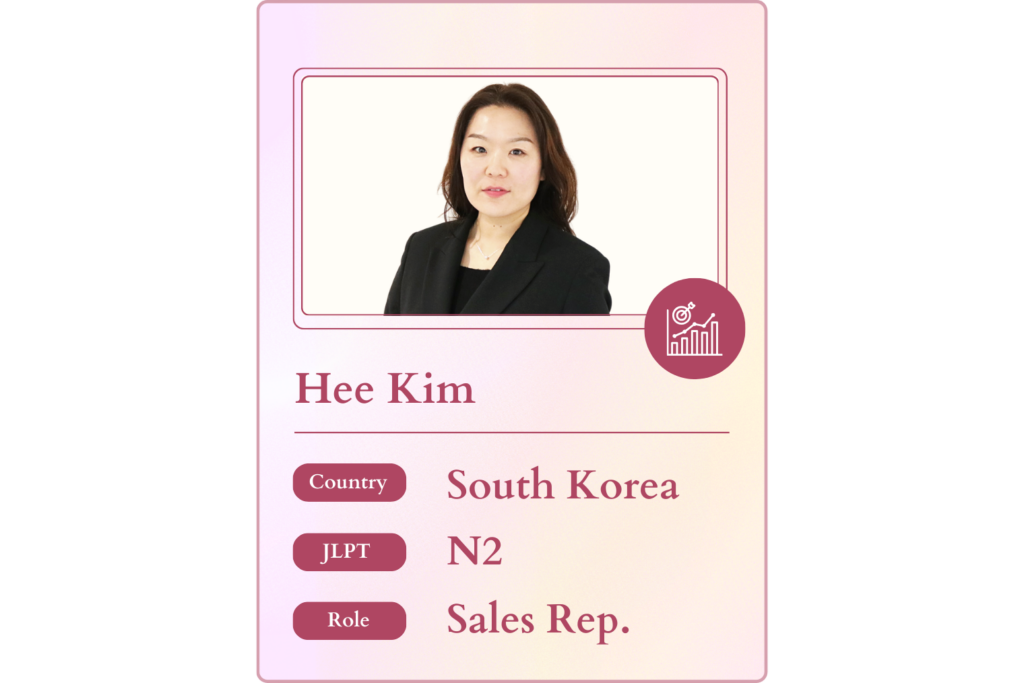
The journey of a global professional taking on a new career challenge in Japan can be deeply rewarding. HEE KIM, a seasoned HR professional who pivoted to a field sales role in Japan, shared her valuable insights in an interview, offering practical advice for others considering a similar move. HEE KIM’s story highlights how veteran experience, coupled with courage and a willingness to embrace new cultures, provides a significant advantage for a Career Change in Japan for Global Professionals.
Q: What was the primary motivation behind pursuing a Career Change in Japan?
Hee: I had always wanted to work in Japan but chose Singapore first due to a better salary and my lack of Japanese skills. After 12-13 successful years of changing companies multiple times in Singapore, I was confident in my ability to manage a career change. Although the salaries are high in Singapore, the standard of living is costly too. On the other hand Japan has job security. That is why I decided to make the bold move to Japan before I got “much older” to avoid regretting the decision later. It was a career challenge I was ready to take on.
Q: How did your professional journey in the HR sector before moving to Japan prepare you for your current field sales role?

Hee: My professional background in the HR sector provided a strong foundation. I worked for nearly four years as an Assistant Training Manager in Korea, handling new graduate hires and HRD. I also served as an operation supervisor at a BPO company. This experience gave me crucial insight into both the HR/hiring team’s perspective and the candidate’s perspective. This cross-functional understanding is highly transferable and helps me align effectively with HR teams in my current field sales role.
🌟Quick Tip: Your past international experience, even if in a different role, is highly transferable in a new market like Japan. Focus on how your understanding of the industry is your unique advantage.
Q: In Japan, frequently changing jobs can sometimes be viewed negatively. How did you navigate this perception?
Hee: In the HR industry, I view my multiple tenures as a benefit because they align with global trends that Japan is now starting to adopt. When asked about my frequent moves, I focused on convincing recruiters that the changes were driven by my strong motivation for professional growth, challenging myself in new roles, and a necessary pursuit of a higher salary in Singapore’s high-cost-of-living environment. My varied experience also gives me a unique advantage as a foreigner in my current role, as I can leverage my own job search understanding to assist candidates and companies.
🌟Quick Tip: During interviews, frame your job changes as deliberate moves demonstrating your drive for professional growth and ability to successfully challenge yourself.
Q: What are the key cultural differences and expectations for foreigners in Japanese companies (Nikkei) compared to foreign-affiliated (Gaishikei) companies?
Hee: The main difference I observe is in efficiency. Decision-making and turnaround times are quicker in foreign-affiliated companies because the approval process in a Japanese company (Nikkei) often involves many redundant layers. When joining a Nikkei company, you must be flexible and tolerant of cultural differences. Remember, Japanese companies hire foreigners because they want “something different.” You must use your unique, international perspective as your strength and be willing to propose innovative ideas, like streamlining the approval or invoicing processes.
🌟Quick Tip: Don’t just adapt—bring value. Japanese companies hire you for your unique perspective; use it to propose positive changes like process improvements or efficiency gains.
Q: How important is Japanese language proficiency?
Hee: I learned that speaking “pretty good Japanese” is a clear prerequisite for success in a Japanese company. Without a solid level of proficiency, productivity can take two to three times longer than for a fluent speaker. This is a critical factor for success.
🌟Quick Tip: Consider “pretty good Japanese” a non-negotiable for success in a Japanese company. Lower proficiency may drastically slow your professional productivity.
Q: Your Japanese skills were still developing when you arrived. How did you overcome language barriers and job search requirements like JLPT N1?
Hee: I initially targeted IT roles like PM or Customer Success Manager, but most online postings required native proficiency or JLPT N1, which I did not have. My strategy was to bypass the online filter. First, I performed a personal SWOT analysis and realized I was still highly marketable in the HR industry. Then, I prioritized in-person networking. I printed my resume and attended a job career fair to meet the HR team directly. I appealed to the recruiter by highlighting my extensive HR and IT experience and arguing that I had “more to offer” despite the language barrier. This brave, motivated behavior sets you apart from native candidates.
🌟Quick Tip: If you can’t meet a high Japanese language requirement online, use the “brave behavior” tactic: attend in-person career fairs and trade shows to appeal to HR with your experience and passion.

Q: What were some surprises you encountered in the Japanese job hunting process and work structure?
Hee: I was surprised by a few things: the competitive salary compared to Singapore and Korea, the higher cost of living, and the vagueness of Job Descriptions (JDs). Unlike the clear JDs in Singapore, Japanese JDs are often general, meaning you are expected to be a generalist, not a specialist. Japanese companies highly value flexibility. I advise newcomers to be ready to take on “extra hats” and commit at least two years before deciding to quit, allowing time to provide feedback to HR.
But this side of Japanese company has helped me gain other skills to expand my potential further.
🌟Quick Tip: Japanese JDs are often vague. Be ready to take on a generalist role and show flexibility; your willingness to handle “extra hats” is seen as a positive sign of preparation for larger responsibilities.
Q: You mentioned using a job portal. What are the advantages of a platform like daijob.com for a Career Change in Japan for Global Professionals?

Hee: A Korean friend who had worked in Japan first recommended daijob.com to me, it has an established legacy of over 15+ years in the market. The main strength I found is its unique synergy between online resources and crucial “offline exposure.” Unlike other purely online job sites, daijob.com connected me to essential real-world opportunities. I was able to attend in-person events, such as the career fair in Akihabara, to meet employers directly. This face-to-face interaction was the key that helped me bypass the very strict JLPT N1 language application requirement that I constantly faced with other online postings. This combination of a robust online platform and the advantage of offline networking is a significant benefit for any global professional looking for a successful Career Change in Japan for Global Professionals.
🌟Quick Tip: The offline events connected to job portals like daijob.com offer a powerful workaround for high language barriers. Use them to make a personal impression that your resume alone cannot convey.
Q: You emphasized networking as a tactic. What is the crucial role of networking for foreign professionals in Japan?
Networking is absolutely crucial for foreign professionals here. Unlike in Singapore or Korea, online community activity on LinkedIn is not as lively; Japanese people prefer offsite, in-person interaction. To truly broaden your network, you must meet people in person, as these interactions often lead to opportunities. I regularly use platforms like Meetup and Tsunagaru to connect with Japanese natives offline. Always view networking with a long-term perspective; you never know when a connection will become helpful.
Q: What are your professional goals and final advice for professionals considering a move to Japan?
My professional goal is to act as a “bridge” or “cupid,” connecting global talent with Japanese and foreign companies in Japan. I view my non-Japanese status as a strength, providing a “third-party perspective” that allows me to better understand the frustrations of both foreign companies and HR personnel. This unique viewpoint allows me to help companies better understand international clientele.
I would like to add that, Japan is generally associated with lower income, but the stability keeps away the anxiety of getting fired, that does bring mental peace. It allowed me to grow, improve my Japanese, and excel in existing skills while stepping out of my comfort zone.
Take Away
HEE KIM’s journey offers a powerful blueprint for a successful Career Change in Japan for Global Professionals. The key takeaway is that your veteran, global experience is not a hindrance but a significant advantage when coupled with a willingness to adapt. Ultimately, by being a “bridge” between cultures and confidently applying your seasoned expertise, you can successfully navigate the unique landscape of the Japanese job market and turn your move into an inspiring “fresh start.”
Discover Your Next Role in Japan. Access more than 10,000 jobs for free!
- Jobs in Japan @ Daijob.com
- Expat Career Guide
- Real Success Stories
- Veteran Experience, Fresh Start in Japan