
- Jobs in Japan @ Daijob.com
- Expat Career Guide
- Real Success Stories
- Hired from Sri Lanka! Software Engineer R’s Story
Expat Career Guide
Hired from Sri Lanka! Software Engineer R’s Story

Is it possible to secure a specialized tech job in Tokyo while living thousands of miles away?
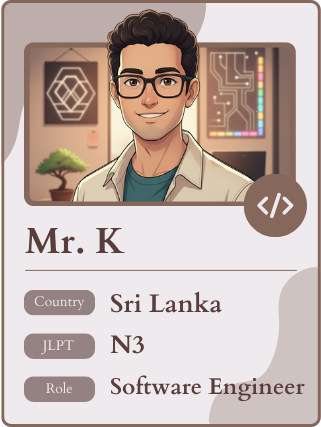
For many international IT professionals, working in Japan is the ultimate goal. However, the path is often filled with questions about language barriers, visa requirements, and interview expectations.Today, we sit down with ‘R’, a 20-something Software Engineer from Sri Lanka. R successfully navigated the complex recruitment process from overseas and landed a job as an AR/VR Software Engineer with a Japanese software vendor in Tokyo.
In this exclusive interview, R shares his strategy, from passing the JLPT to acing the technical interview. Whether you are a developer, an engineer, or a tech enthusiast, his journey offers a clear blueprint for securing a software engineer role in Japan.
Q1: What Motivated You to Pursue an IT Career in Japan?
Interviewer: Many people dream of Japan, but you turned that dream into a reality. What was the driving force behind your decision to leave Sri Lanka and work in Tokyo?
R: It was a combination of two things: my personal interests and my professional frustration. Like many people, I have a deep fascination with Japanese culture, specifically anime and video games. I always wanted to experience life there. Professionally, I felt stuck. My previous role in Sri Lanka didn’t offer much career growth. The company claimed to offer specialization, but I often found myself doing tasks completely unrelated to my domain. I knew I needed a change. I wanted to combine my admiration for Japan with a serious IT career that focused specifically on Augmented Reality (AR) and Virtual Reality (VR).
💡 HR Expert Tip: The Power of “Why”
Japanese recruiters pay close attention to your Shibō Dōki (Reason for Applying). R succeeded because he connected his personal passion for the country with a specific professional goal.
- Takeaway: When applying, don’t just say you love Japanese food or culture. Explain how your specific skills (like AR/VR) can contribute to the Japanese tech market.
Q2: How Did You Prepare for the Japanese Job Market?
Interviewer: Moving overseas is a huge step. How long did the process take, and what did you focus on during your preparation?
R: The entire process took about 4 to 6 months from the time I started applying until I received the offer. My main priority was language. I knew that even for technical roles, knowing Japanese is a huge advantage. I studied hard and achieved the JLPT N3 level (Daily Communication level). This allowed me to read basic job descriptions and handle simple conversations. I also didn’t apply to every job I saw, I was very selective. I applied only to the position I had set my mind on like Software Engineer or related to that.
💡 HR Expert Tip: The Language Bridge
While “English-only” jobs exist, they are highly competitive. Achieving JLPT N3 is often the “sweet spot” for engineers. It shows employers that you respect the culture and can handle daily office interactions.
- Resource: Start with standard textbooks like Minna no Nihongo to build your foundation.
- External Link: Learn more about the language levels at the Official JLPT Website.
Q3: What Was Your Strategy for the Application Documents?
Interviewer: Japanese resumes are quite different from Western ones. How did you handle the application paperwork?
R: I realized I couldn’t just use my standard English CV. I spent time customizing my resume for the Japanese market. Focusing on the “cultural fit” aspect as much as my technical skills. I wanted them to see that I could adapt to a Japanese team environment.
💡 HR Expert Tip: Resume Customization
Japan uses two specific documents: the Rirekisho (Standard Resume) and the Shokumu Keirekisho (Career History Sheet).
- Advice: Don’t just translate your English CV. Use a Japanese format that highlights your project history in detail. Tools like Daijob.com offer features to help generate these standard Japanese formats.

Q4: How Did You Ace the Interview and Technical Check?
Interviewer: Interviews are stressful, especially in a second language. How did you prepare for the questions, and how did you prove your technical skills?
R: For the interview questions, I used a specific method. I first drafted my answers in English to ensure my ideas were clear and logical. Then, I carefully translated them into Japanese to check the grammar and vocabulary. This helped me memorize the key points I wanted to convey. For the technical side, it was rigorous. I had to fill out a detailed skill sheet. But more importantly, I provided proof. I sent them demo videos of my AR/VR work and links to my project repositories (like GitHub).
💡 HR Expert Tip: Evidence Reduces Risk
Hiring from overseas is a risk for companies. They worry about communication gaps.
- Why R Won: He used visual evidence. Code and demo videos are a universal language. Even if his Japanese wasn’t perfect, his videos proved he could do the job. Always include links to your portfolio or GitHub in your application.
Q5: Why Did You Accept This Specific Offer?
Interviewer: You eventually received an offer from a software vendor in Tokyo. What were the deciding factors for you?
R: The offer was solid. The starting salary is between 3 million and 4 million Yen annually. But money wasn’t the only factor. I looked at three main things:
- ・Professional Growth: The Job Description promised real skill advancement in AR/VR.
- ・Location: It was in Tokyo, which was my dream location.
- ・Cultural Fit: I saw opportunities to use and improve my Japanese language skills, and the company benefits were good.
💡 HR Expert Tip: Evaluating the Offer
Look beyond the base salary. Consider commuting allowances, housing support, and insurance. Tokyo is expensive, but it offers the highest number of career opportunities.
Q6: What Are Your Worries and Future Plans?
Interviewer: Now that you have the job, how do you feel? What is your plan for your first few months in Japan?
R: I would rate my current satisfaction at an 8 out of 10. I am very excited, but I am also realistic. My biggest worry is the probation period. I want to make sure I meet their expectations immediately.
My plan for work-life balance is simple: take it slow. In the beginning, I will focus heavily on refining my Japanese language skills and understanding the company workflow. Once I am settled, I will focus more on keeping up with new career trends in the industry.
💡 HR Expert Tip: The Long-Term Mindset
R’s focus on the probation period is wise. In Japan, the first 3 to 6 months are crucial for building trust.
- Advice: Don’t rush to change things in the company immediately. Observe, learn the team dynamic, and show reliability first.
Q7: What Tools Helped You Find This Job?
Interviewer: You mentioned you found this role while in Sri Lanka. What platform did you use?
R: I used Daijob.com. It provided exactly what I needed to find a job in Japan. General job boards were too broad. Daijob was helpful because:
・Global Focus: It had a high number of “global” job opportunities that welcome foreigners.
・Detailed Search: I could filter specifically for “AR/VR” and niche criteria.
・Guidance: I read their Global Career Guide Blog to understand how to interview and write resumes for Japan.
Q. 8 Final Advice for Foreign Job Seekers
Interviewer: Finally, what is your message to other engineers around the world who want to follow in your footsteps?
R: My advice is simple: “Always convey your passion through your projects and communication.”
Don’t just list skills on a paper. Show them what you have built and tell them why you care about it. That energy crosses language barriers.
Take Away

R’s final advice succinctly captures a critical element of success in the Japanese job market. It’s not enough to merely state your skills; you must demonstrate your passion and competence. This message reinforces the earlier insight about the technical round, where R provided demo videos and project repository links. For Japanese companies seeking specialized talent like an AR/VR Software Engineer, quantifiable proof and enthusiastic communication act as a powerful tool to bridge any language or cultural gaps. Your projects are your strongest testament—they are the direct, undeniable evidence of your dedication and expertise.
Ready to Start Your Journey?
R’s story proves that with the right strategy, specialized skills, and a bit of language preparation, you can secure a software engineer role in Japan from anywhere in the world.
Do you have a portfolio ready? Are you studying Japanese? Take the first step today!
Explore the global job market and find the company that needs your unique talent.
Discover Your Next Role in Japan. Access more than 10,000 jobs for free!
- Jobs in Japan @ Daijob.com
- Expat Career Guide
- Real Success Stories
- Hired from Sri Lanka! Software Engineer R’s Story