
- Jobs in Japan @ Daijob.com
- Expat Career Guide
- Real Success Stories
- Securing a High-Growth Role in Recruitment and Consulting
Expat Career Guide
Securing a High-Growth Role in Recruitment and Consulting

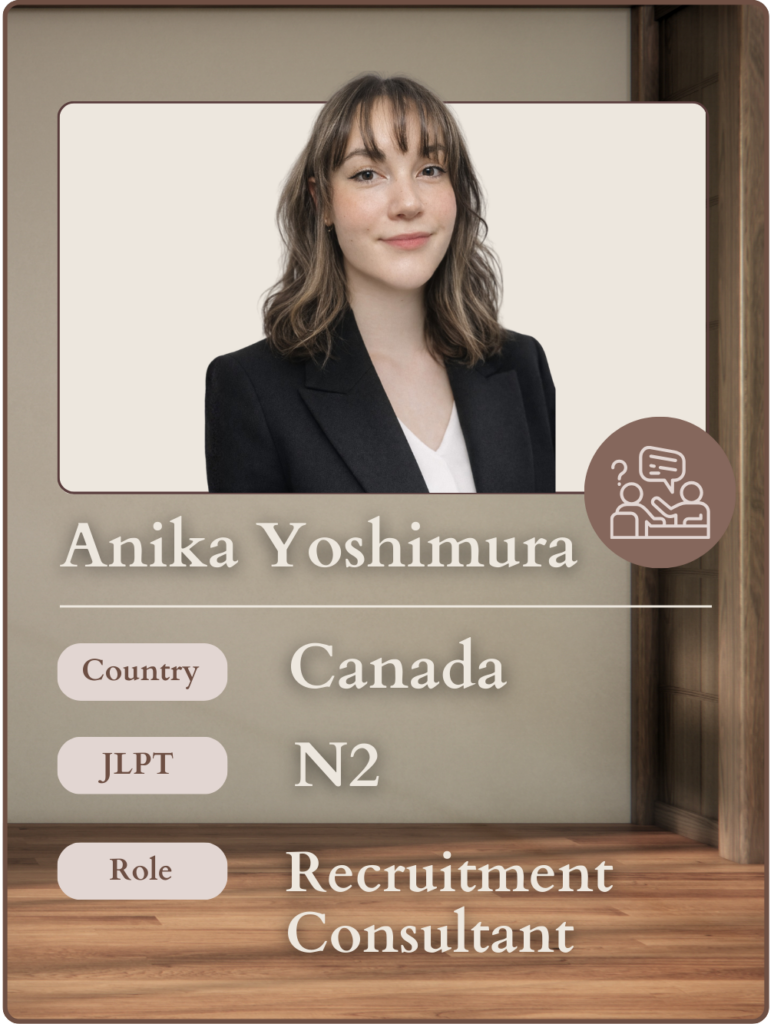
Breaking into the Japanese corporate world requires more than just language skills; it demands a strategic mindset and a refusal to settle. In this detailed Q&A, we speak with Anika Yoshimura (Kuzyk), a Canadian professional who has lived in Japan for five years. She recently made a significant career shift from English teaching to recruitment and consulting.
Anika offers an honest account of the hurdles she faced, her highly effective application strategy, and how a specific platform turned her “absolutely awful” job hunt into a successful career launch.
Background and Immersion in Japanese Culture
Q: Can you tell us about your background and how you first came to live in Japan?
A: I’m currently 29 and turning 30 this year. I’m a Canadian national, originally from Alberta, but I completed my Master’s degree at the University of British Columbia. My time in Japan has been about five years on and off, but for the past two years, it’s been solid. Prior to that, I did quite a few language programs and student exchanges, including a six-month exchange in Hokkaido during high school and a year-long program at IUC (Inter-University Center) for business Japanese.
Q: Your last name is Japanese. Is that a result of your marriage?
A: Yes, I recently got married, and my husband is Japanese. But the funny thing is, we actually mostly speak English to each other because he spent about six years in Tennessee. So, while having a Japanese husband does help, we communicate primarily in English.
Q: With all that time spent studying, how did you first get interested in Japanese language and culture?
A: I started learning Japanese in high school because it was offered, and I found out I really liked it. Coming from Canada, you’re essentially forced to learn French, and I was so bad at it! Japanese made a lot more sense to me. My interest started very young through movies and later K-Pop, which eventually led me to anime. My favorite Studio Ghibli movie is My Neighbor Totoro, and the first manga I ever bought was Death Note.
The Difficult Job Hunt and Career Change
Q: How did you land your first “real” job in Japan?
A: I started job hunting in Japan from Canada, which proved to be an absolutely awful experience. Traditional Japanese companies were very skeptical about my lack of local experience and the fact that I didn’t yet have a visa. My first job here, which was English teaching, ultimately came from getting scouted by Daijob.com.
💡 Pro Tip: The Power of Local Scouters
Job hunting from overseas is often met with silence due to visa complexities. Utilizing platforms with active scouts who understand the “Global to Japan” pipeline is often the only way to bypass the initial “no-visa” filter.
Q: You’re now moving into recruitment and consulting. Can you describe your new role?
A: I’ll be starting as an Associate, which is a training period where I’ll be learning the ropes of recruitment and cold calling. After that, I will move on to a Talent Coordinator role. I have a wide background in sales and management from various retail jobs in my early 20s, which the company saw as valuable, alongside my Japanese language skills.
Q: What was the main motivation to leave English teaching for consulting?
A: I felt my skills were being wasted. Every company looks at you as just a foreigner who teaches English, no matter how many degrees you have. My Master’s degree and N1/N2 level Japanese were much more suitable for consulting. Also, the salary was a large deciding factor—the new job offers a much more attractive salary with commission after training. I love helping highly skilled foreigners, like those in IT or finance, find meaningful positions.

Workplace Challenges and Application Strategy
Q: Can you describe the difficulties you had with translation companies during your job search?
A: The worst part was the demand for free work in the form of a trial. I would often be asked to complete a trial that took about 11 hours with very short deadlines. Frustratingly, many companies would receive my work and then simply say, “No thanks,” without providing any feedback. It left me wondering if they were truly unhappy or just using me for free work.
Q: Did you face any cultural barriers in your previous job regarding your Japanese fluency?
A: Yes. Despite being relatively fluent, I was often forced into a situation where a co-worker had to translate for me when I could just do it myself. The excuse was always that parents were paying for a “native English teacher”. It was frustrating to have my Japanese fluency appreciated for internal team communication, but then be told it would be “better if I spoke less Japanese” in front of clients.
Q: What was the key to your effective application strategy for securing the consulting job?
A: A highly personalized cover letter was key. I found that if I applied without one, I never heard back, but with one, I got a reply 8 out of 10 times. I was also honest about my lack of direct experience in consulting, focusing instead on how my sales and customer service skills in Japan were transferable.
💡 Pro Tip: Don’t Fake It, Map It
If you are changing careers, don’t pretend to know an industry you haven’t worked in. Instead, focus on “Transferable Skills”—show how your previous customer management or language proficiency directly solves a problem for the new employer.
Leveraging the Right Tools: Why Daijob.com Worked
Q: You’ve expressed a lot of satisfaction with your job search results this time around. What role did the platform play?
A: Almost everything I did was through Daijob.com. I actually like the system the best out of all the ones available. I spent a lot of time searching through pages using specific keywords to see what was out there.
Q: Was there a specific feature that made the difference?
A: The scout system was very nice. Even for jobs I didn’t directly apply to, receiving a scout email meant the company was already interested in my profile. It made the interview process much faster. In fact, I heard back and got interviews much quicker with scouted roles than with direct applications.
Q: You mentioned Blaine specifically. How did that personal connection help?
A: I actually applied months prior and forgot about it. But Blaine reached out via a scout email and asked if I was still interested. Having a scout or someone recommending you is a much faster way to get in. The scout system on the website is extensive and highly effective.
Final Advice and Outlook

Q: What is your best piece of advice for other foreigners looking to work in Japan?
A: Don’t let rejection affect you. I felt stuck in English teaching for so long, thinking I’d be there forever. Some people may not like foreigners, but you cannot let that xenophobia influence you. Be consistent in applying, networking, and socializing. The right career and the right job will come along when you’re ready for it.
Final Thoughts
Anika Kuzyk’s story is a narrative of resilience. Her move from a role that undervalued her academic strengths to a rewarding consulting career is an inspirational lesson for all foreign professionals in Japan.
Is your salary keeping up with your potential? Register your CV on Daijob.com today and activate the Scout System to let your next career opportunity find you!
Discover Your Next Role in Japan. Access more than 10,000 jobs for free!
- Jobs in Japan @ Daijob.com
- Expat Career Guide
- Real Success Stories
- Securing a High-Growth Role in Recruitment and Consulting