
- Jobs in Japan @ Daijob.com
- Expat Career Guide
- Real Success Stories
- Transitioning to a Career in Japan: Lessons from a MEXT Scholar
Expat Career Guide
Transitioning to a Career in Japan: Lessons from a MEXT Scholar

Transitioning from a career in Japan for international students to a full-time professional role is a major milestone. In 2026, the Japanese job market offers incredible opportunities for those who prepare early and use the right tools.
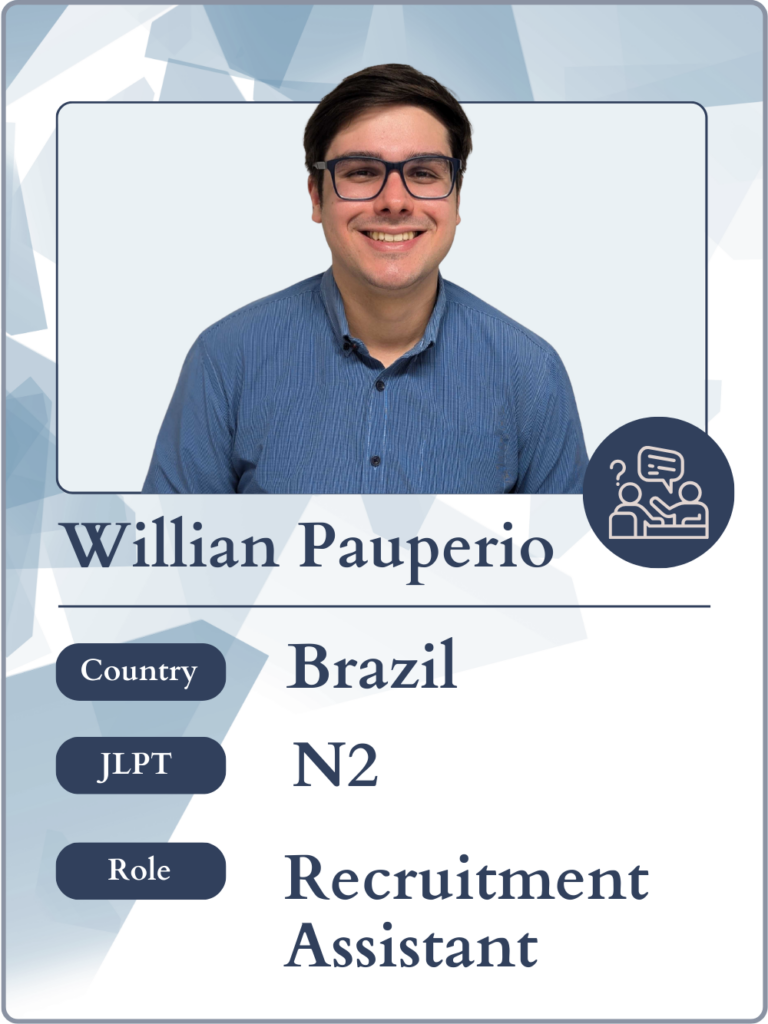
Today, we speak with Willian, a 27-year-old Brazilian professional who successfully navigated this journey. Willian moved to Tokyo as a MEXT scholar and recently secured a role as a Recruitment Associate through Daijob.com. (Willian is currently a Recruitment Assistant and will join his firm as an Associate in April 2026.)
One of the most inspiring aspects of Willian’s transition is the significant jump in his earning potential. Moving from a student lifestyle and part-time work to a professional Associate role resulted in a substantial financial boost of 1 Million Yen!
In this interview, he shares his roadmap for moving from a student visa to a professional career.
Part 1: The Brazilian Foundation and the MEXT Scholarship
Q: Willian, many people dream of a career in Japan for international students. What was your life like before moving to Tokyo?
Willian:
In Brazil, I worked for a company called “Great Place to Work”. They rank the best companies to work for globally. I started there as an intern and moved into a sales-related role. I was also studying International Relations.
My first experience in Japan was as a volunteer from 2017 to 2019. I truly loved the culture. After returning to Brazil, I decided I wanted to come back. I did not want to lose the Japanese language skills I had gained.
Q: You eventually received the MEXT scholarship, right? How was that process?
Willian: Yes, I applied for the MEXT scholarship from the Japanese government. It was not easy. In fact, it took me three tries to pass. This scholarship allowed me to study at the Bunka Institute of Language in Tokyo. I have been studying there for three years now.
💡 Pro Tip for Students: The MEXT scholarship is highly competitive. If you fail the first time, analyze your weak points and try again. Persistence is the first step toward a career in Japan for international students.
Q: Many people find the scholarship process very difficult. What was your biggest challenge when you arrived?
Willian: The paperwork and administration were the biggest challenges at first. It felt like a maze. The first few weeks were also a bit lonely. However, living in a dorm with friends helped me a lot.
Part 2: Reality Check – The Japanese Work Culture
Q: You have lived in Tokyo for a total of about five years now. What is your honest take on the work culture?
Willian: People often warn you about the work culture in Japan. They say it can be very demanding. However, I believe you have the power to choose your environment. You must study the company culture before you join.
I am quite picky with my choices. I currently work a part-time job at a big mobile brand’s store in Harajuku. It is a very healthy environment. This experience taught me that not every Japanese workplace is the same.
Q: What is the biggest difference you noticed between Brazil and Japan?
Willian: In Brazil, we focus heavily on the result. The process is important, but the result is what we want. In Japan, there is a much bigger emphasis on the process itself. People follow the “book” very closely. Every step must follow the established rules.
Part 3: Language Skills – Moving Beyond the Classroom
Q: You hold the JLPT N2 and the BJT J2 proficiency. How did these help during your interviews?
Willian: For my current role, I went through five rounds of interviews. While the interviews were mostly in English, they switched to Japanese to check my fluency. They wanted to see if I could handle professional conversations.
Q: How do you use these skills in your current role?
Willian: Right now, I am an intern, but I will become an Associate in April. I use English for LinkedIn and internal communication. However, when I am on the phone headhunting candidates, I speak entirely in Japanese.
Q: Many expats feel “stuck” at the N2 level. What habit helped you move to “business-ready” Japanese?
Willian: My vocational course focused on business translation and interpretation. That helped a lot. But the best thing was getting a part-time job before working full-time. Even if it is just a service job, you learn how to use polite language in real situations.

Q: Did learning business manners make a difference in your job search in Japan?
Willian: Absolutely. Small details are very important. For example, you must know how to handle a business card. You should not put it in your wallet immediately. You must keep the name visible and place it carefully. These things are vital in sales and consulting.
💡 Pro Tip for Students: Don’t just study for the JLPT. Take the BJT (Business Japanese Test) to prove you understand office etiquette. Also, get a part-time job in a service-related field. It is the best way to practice Keigo (honorific Japanese) in a real setting.
Part 4: The Shukatsu Strategy – Starting Early
Q: When should a student start their career in Japan for an international student search?
Willian: I started my Shukatsu (job hunting) in January of last year, even though I didn’t graduate until March of this year. That means I searched for about seven months before securing my path.
Q: Why did you start 14 months before graduation?
Willian: I didn’t want to settle for just any job. I wanted a good salary and a healthy environment where I could grow. By starting early, I could “test the waters”. I applied to random companies first just to get interview practice. By the time I interviewed with my target company, I felt very confident.
I tell my friends to start as early as possible. Big companies have very fixed schedules, often starting a year before graduation. Smaller companies are more flexible, but you still need time to “test the waters”.
💡 Pro Tip for Students: Big Japanese firms often have fixed hiring schedules that start a year in advance. If you wait until your final semester, you will miss out on the best roles. Start your career in Japan for international students by searching at least 12 months before you graduate.
Part 5: The “Sandwich Method” for Professional Interviews

Q: How did your strategy change once you became serious about your job search in Japan?
Willian: After three or four months, I stopped being casual. I began studying companies deeply; Tailored my “Shibo Doki” (reason for applying) for the roles I truly wanted. I focused my mindset on recruitment and consulting.
Q: How do you handle “Self-PR” in a way that sounds professional and not arrogant?
Willian: My school taught us a specific method for interviews. We call it the “sandwich” method:
1. State your strength: Say exactly what you can do.
2. Provide an episode: Give a short example of a past situation and how you fixed it.
3. Confirm the strength: Repeat your opening statement to close the point.
Q: Did this help you stand out?
Willian: Yes, because you are providing evidence. Instead of just saying “I am a hard worker,” you are showing them how you work. This is vital for a career in Japan for international students.
Part 6: The ¥1 Million Leap – Negotiating Your Worth
Q: You mentioned in your survey that your annual income changed by over ¥1 million. How did that impact your decision to accept the offer?
Willian: Honestly, I really like a good salary. It was a major non-negotiable priority for me. While I also value a healthy work environment and nice people, the financial growth was a key motivator. Finding a place that offered both—a great team and a ¥1 million increase—was the best of both worlds.
Q: For a student, a ¥1 million raise feels nearly impossible in traditional Japanese companies. How did you secure it?
Willian: You have to know what you are bringing to the table. I didn’t just ask for more money; I proved my value through my internships and past experiences. Even though the training period starts at a standard rate, the path to that increase was clearly defined based on my growth into the Associate role. It makes you feel satisfied and truly invested in the path.
💡 Pro Tip for Students: A career in Japan for international students can be lucrative if you aim high and do your research. Don’t just settle for the easiest “entry-level” pay. Study the market benchmarks, analyze your specialized skills, and choose companies like those found on Daijob.com that specifically reward global talent with competitive compensation.
Part 7: Why the Daijob Career Fair is a Game Changer
Q: You found your current role through Daijob.com. What made the platform different?
Willian: I actually found my company on the Daijob.com website first. I applied online, but I didn’t get an answer right away. I am very persistent, so I checked their schedule and saw they were attending the Daijob Career Fair.
Q: You met them in person?
Willian: Yes! I went to the Daijob Career Fair specifically to talk to my current company. It was summer and very hot, but I put on my suit and went anyway. I knew the team from LinkedIn and their website. Meeting them in person made a huge difference.
I spoke with everyone- managers, senior staff, and even the CEO. I gave them my resume directly. A few days later, a recruiter from Daijob contacted me to start the formal process. Online applications are limited. Sometimes you might not get an answer. But if you go in person, you can show your personality. You can prove you speak the languages. You leave a strong impression that an online profile cannot match.
Q: Do you recommend the platform to other students?
Willian: Absolutely. The website gave me personalized recommendations based on my resume, which focused on recruitment roles. But the career fair was the real key. It allowed me to bypass the “online silence” and make a real human connection.
💡 Pro Tip for Students: Online applications are a good start, but career fairs are where deals happen. Meeting a CEO face-to-face shows more initiative than an email ever will.
Part 8: Final Advice – Finding Your Perfect Match
Q: What is your career goal for the next five years?
Willian: I want to become a pro in consulting. I am totally invested in this path. I want to truly understand the Japanese market and help other professionals find their place here.
Q: What challenges do you see for foreign professionals in Japan recently?
Willian: Immigration rules seem to be getting tighter and more expensive. This might be a challenge for newcomers. People may become more picky about their careers. However, I still think many people want to come to Japan. My goal is to help established professionals navigate these changes.
Q: Rejection can be very discouraging. How do you handle it?
Willian: My teacher told me that rejection is just a matter of “matching”. It does not mean they hate you. It is like meeting people in your personal life. Sometimes you just do not “click”. You must keep looking until you find the company that clicks with you. Do not be fake; just keep looking for the right match.
Take the Next Step in Your Career

Willian’s transition from a student to a Recruitment Associate shows that a career in Japan for international students is within reach for anyone with a clear plan. By starting early, mastering professional manners, and using platforms like Daijob.com, you can turn your student visa into a thriving professional career.
If you are ready to find your perfect match in the Japanese market, start today.
・Be Proactive: Do not wait for an answer online. Attend events and meet employers face-to-face.
・Be Prepared: Master your “Self-PR” and learn local business manners.
・Be Persistent: Rejection is just a step toward finding the right fit.
Are you ready to start your journey? Don’t wait until graduation. Register on Daijob.com today and attend the next Career Fair to meet your future employer face-to-face!
Discover Your Next Role in Japan. Access more than 10,000 jobs for free!
- Jobs in Japan @ Daijob.com
- Expat Career Guide
- Real Success Stories
- Transitioning to a Career in Japan: Lessons from a MEXT Scholar