
- Jobs in Japan @ Daijob.com
- Expat Career Guide
- Real Success Stories
- Overseas Father’s Guide to Job Success in Japan: Securing a Future for Your Children
Expat Career Guide
Overseas Father’s Guide to Job Success in Japan: Securing a Future for Your Children
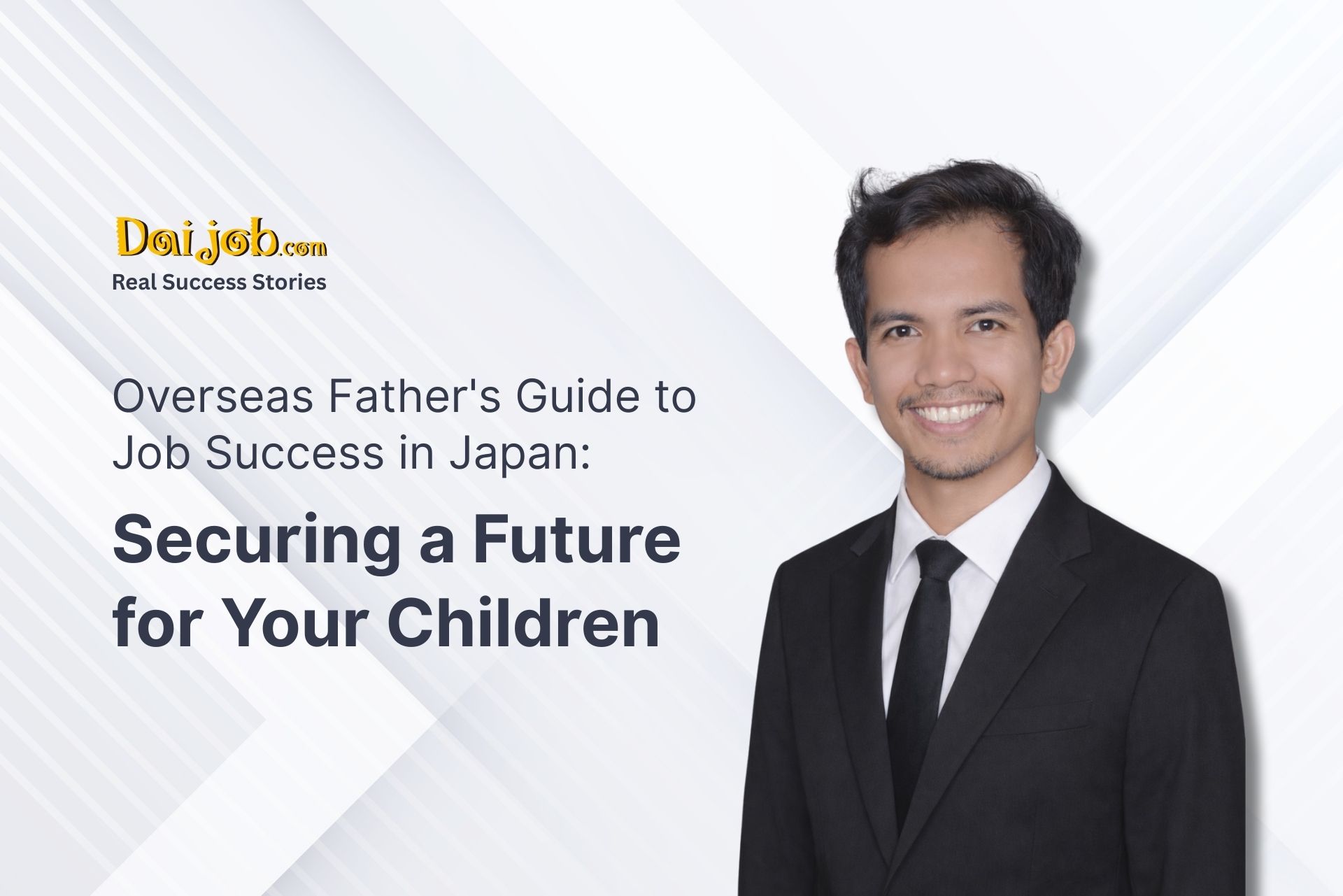
We recently spoke with DWIFA DANIEL AUGUSTO, an experienced engineer from Indonesia who successfully navigated the Japanese job market to start a new life in Osaka. His story is an inspiring testimonial for every “overseas father” looking for career opportunities and a safe environment for their family. This interview, framed as an Overseas Father’s Guide to Job Success in Japan, offers practical advice for foreign professionals.
The Journey to Japan: Motivation and Master’s Degree
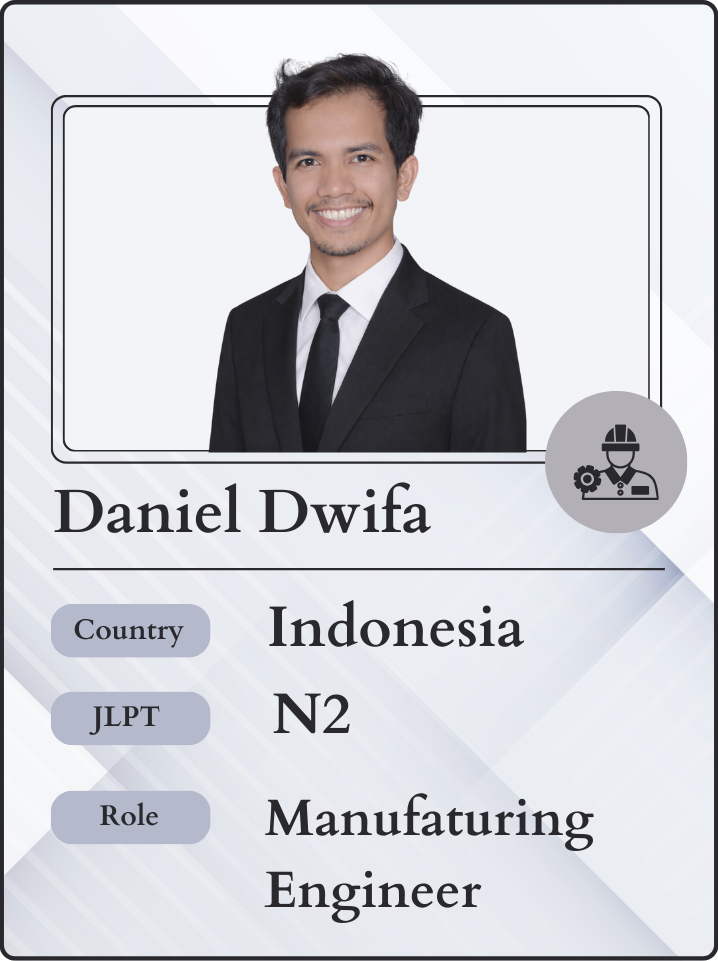
Q: Your journey to Japan seems to have multiple phases. What initially brought you here?
Daniel: My father spent his entire career working for a Japanese company. So, growing up, I was already very familiar with the Japanese work environment and culture. That early experience influenced my career choices. I first came to Japan in 2019 for a work project in Oita. I immediately felt it was a “nice country to live” and pursue a career because it felt comfortable and “not really so bustling”. That positive impression motivated me to return in 2023 for my Master’s degree at Osaka University.
Q: You are fluent in five languages, including English and Japanese (N3 certified). How did you master Japanese?
Daniel: I actually self-studied Japanese initially in Indonesia, but working full-time made it difficult to manage the time, so I quit the course. When I started my Master’s at Osaka University, I took classes there and continued self-learning while working part-time. I achieved the N3 certification through a mix of university classes and self-learning. Every aspiring “overseas father” should know that being proficient in Japanese is one of their strongest tools for job success in Japan.
Q: Did you experience any culture shock upon moving here?
Daniel: The biggest initial shock was definitely the garbage separation rules. In Indonesia, we put all waste—recyclable and kitchen waste—in one place. When I first moved, I was shocked to find my garbage left uncollected until a friend taught me the correct sorting process. Each city, like my current home in Toyakashi, even requires you to buy special plastic bags. It’s challenging, but a sign of the country’s discipline.
Building a Family Life in Osaka.
Q: You chose Osaka over a city like Tokyo. What were the deciding factors for your family?

Daniel: Tokyo is extremely expensive. I chose Osaka because it’s a big city but more affordable, making it the “middle one” that allows me to afford a comfortable life while still being able to bring my family along. The most important factor, however, is safety. I have young children who often go out by themselves, so safety is my number one priority. Japan offers a fantastic, safe environment for raising a family.
Q: How has your family—specifically your two young children—adjusted to life in Japan?
Daniel: The initial adjustment was the toughest for my youngest son, who was only four years old when he arrived in December 2023. He struggled at first because nobody at school spoke English, and he barely knew any Japanese. Now, both children are doing great and attend Japanese schools. They adjusted so well that my youngest son now barely speaks Indonesian; he mainly uses Japanese and English. They are very well-adjusted, and their seamless assimilation gives me hope for a bright future for them here.
Job Success and Career Tips
Q: How do you maintain work-life balance, especially with a new job and young children?
Daniel: Job success in Japan also means prioritizing family time. I make sure to spend the weekends with my family. Japan’s public transportation is excellent, unlike my home country, where you need private transport like a car or motorcycle. Even without owning a vehicle, we can easily take weekend trips to nearby places like Kyoto or Nara. For me, a “nice life” is seeing my children happy and able to pursue their interests, like my older son with soccer and my younger son with swimming lessons. My current salary is enough to provide for them.
Q: You transitioned from a foreign-affiliated company to a purely Japanese (Nikkei) company. How did the work styles compare?
Daniel: I didn’t find many significant differences in the core rules or discipline. The main difference is the communication style. In a very large, major company, you might use highly polite Japanese, or keigo. At my current Japanese company, most employees are in their 30s, 40s, and 50s, so we talk more “like friends”. This casual environment makes it easier to learn the work-related Japanese vocabulary.
Q: Is the overtime culture in Japan as intense as rumors suggest?
Daniel: Surprisingly, I do less overtime in Japan than I did in Indonesia. In my previous engineering role in Indonesia, there were extreme demands—I’d sometimes be at the office for 24 hours, or even get called back at 3:00 a.m. for emergencies. The Japanese work environment, for me, provides a much better boundary and work-life balance.

Q: What was your strategy for achieving mid-career job success in Japan after your Master’s?
Daniel: After realizing that my extensive work experience disqualified me from “fresh graduate” job fairs, I focused on mid-career applications. I used job search platforms like Daijob.com and others recommended by my university. My search strategy was to use keywords related to my degree, but I intentionally avoided using “foreigner” as a keyword so I wouldn’t limit my options.
Q: How did Daijob.com assist you in your job search?
Daniel: I found my current company listed on your platform and applied through it. I have two points to highlight:
1. High-Quality Translation:
The platform’s translation of job content from Japanese to English was incredibly helpful. Japanese job descriptions often use difficult kanji, and accurate translation is crucial for understanding the responsibilities and training.
2. Resume Auto-Translation:
The auto-translation of my resume from English to Japanese was a lifesaver. Translating it myself often resulted in “weird sentencing”. This feature helped me, as a foreign applicant, increase my chances with Japanese companies by presenting a professionally translated resume.
Q: What is the most important piece of advice for a foreigner preparing for a Japanese job interview?
Daniel: You must prepare two basic things:
1. Know the Company:
Research their vision, products, and business practices.
2. Know Your Background:
Experienced candidates need to explain their previous job content simply and effectively. Interviewers may not know your specific industry background, so keep your explanations clear.
The most difficult question for me was about my five-year or midterm goals. Companies want commitment, so it is important to answer in a way that shows your plan aligns with your growth within their organization.
Final Thoughts: A Father’s Vision

Q: What is your main motivation for continuing your career in Japan?
Daniel: My main motivation is giving my children a “different future”. Staying in my home country would mean a similar path for them. Moving overseas exposes them to new cultures, new rules, and a new way of life, and I believe this will be a great experience for them. I am most certain that this will help me to provide them with a better life.
Q: What advice would you give to other parents concerned about moving their family to Japan?
Daniel: Japan is the “best place” to challenge your children. Japanese society does not “differentiate you” or “put you in the box because you are a foreigner”. As long as you respect the country and its culture, and actively try to “blend in,” you will receive reciprocal respect and have nothing to worry about.
Take Away
DWIFA DANIEL AUGUSTO’s successful career move to a purely Japanese company in Osaka was primarily motivated by his desire to build a safe, affordable, and prosperous future for his family, a goal he achieved with the help of job platforms like Daijob.com. Despite the initial cultural shock of garbage sorting and his youngest son’s language barrier, his family is thriving, with both children quickly assimilating into Japanese schools and gaining a better command of the language than their father. The new role provides him with a higher salary and a better work-life balance than his previous engineering job, allowing him to spend valuable weekends exploring Kansai with his family. His advice to other expat parents is to embrace the culture and “blend in” to secure a bright future.
For other parents embarking on this journey, external resources can provide valuable assistance with family life in Japan. You can find helpful information, such as guides on raising children in a multicultural environment, through resources like the Tokyo Multilingual Living Guide for Foreign Parents.
Discover Your Next Role in Japan. Access more than 10,000 jobs for free!
- Jobs in Japan @ Daijob.com
- Expat Career Guide
- Real Success Stories
- Overseas Father’s Guide to Job Success in Japan: Securing a Future for Your Children