
- Jobs in Japan @ Daijob.com
- Expat Career Guide
- Expat Essentials
- Japan ID Unification: Zairyu Card & My Number Merge Explained
Expat Career Guide
Japan ID Unification: Zairyu Card & My Number Merge Explained
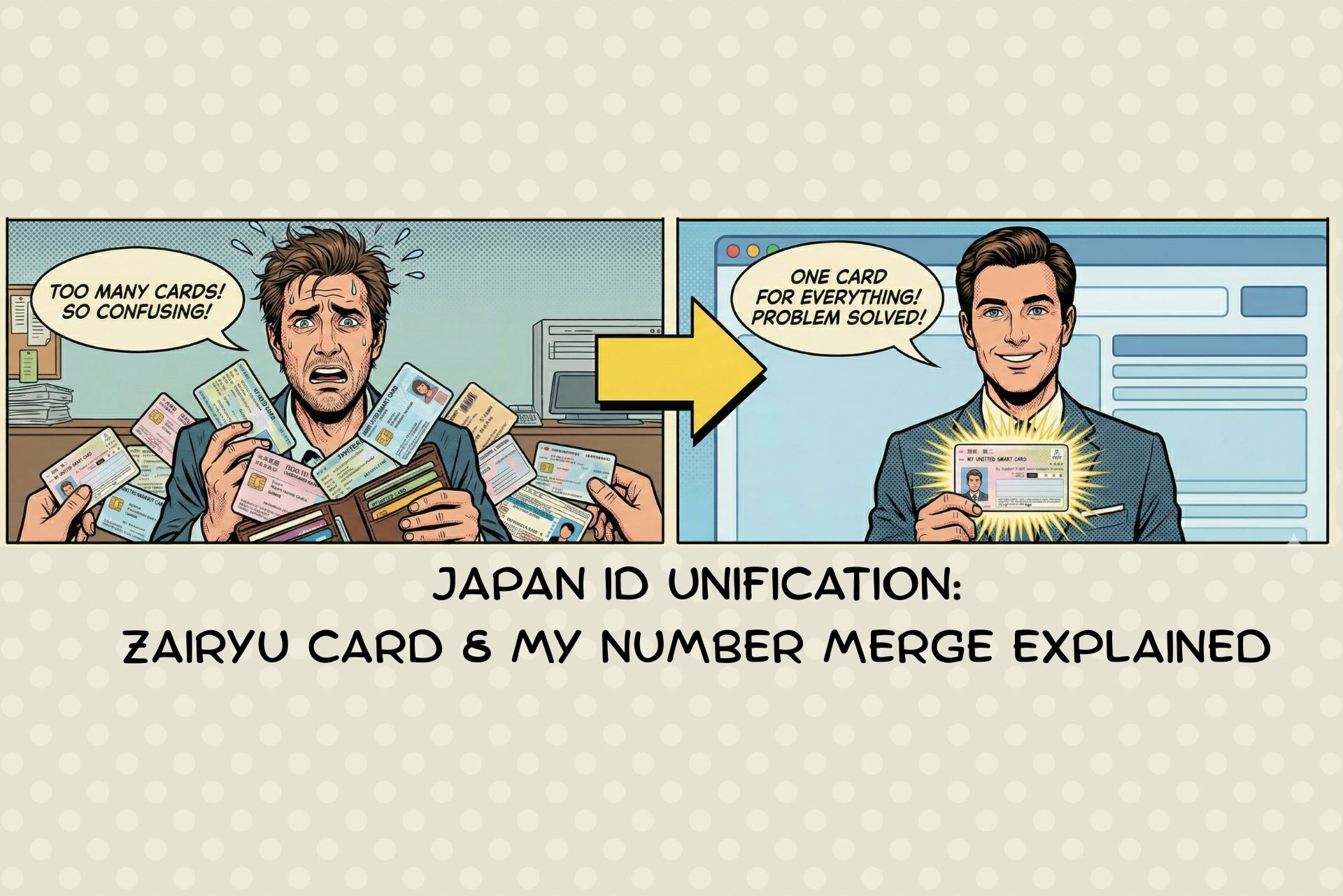
For years, foreign residents have juggled multiple plastic cards: the Zairyu Card for immigration, the My Number Card for taxes, and a separate health insurance card for medical visits. Keeping track of all three has been a hassle.
Imagine carrying just one card for everything in Japan. You use it to prove your visa status, visit the doctor, pay your taxes, and open a bank account. This convenience is coming soon.
You probably already know that the My Number Card has replaced the traditional health insurance card as of late 2024. Now, the government is taking the next massive step: merging the Zairyu Card (Residence Card) into this system. But the Japanese government is moving fast. The “Myna Insurance Card” is already a reality. Next, the Zairyu Card is joining the mix to create a powerful all-in-one ID.
This guide explains the unification of the Zairyu Card and the My Number Card. We tell you what is changing, when it happens, and how it makes your life easier.
What is the Current System?
To understand the future, we must look at where we stand right now. The landscape has shifted significantly in the last year.
1. The Zairyu Card (Residence Card)
The Immigration Services Agency (ISA) issues this card. It proves you live in Japan legally. It lists your name, address, visa type (like “Engineer” or “Student”), and how long you can stay.
The Rule: You must carry this card 24 hours a day. Police can ask to see it at any time.
The Problem: You must go to the Immigration Bureau to update it. This often means long lines and hours of waiting.
2. The My Number Card (and Health Insurance)
The My Number system was originally just for Social Security and taxes. But recently, it became much more important.
The Big Change (Dec 2024): As of December 2, 2024, Japan stopped issuing new paper/plastic health insurance cards. The My Number Card effectively became the standard health insurance card (known as Myna Hokensho).
The Function: You now use this card at hospitals and pharmacies. It links your medical data and insurance status directly to the IC chip.
Currently, you likely carry two cards: the Zairyu Card (for police/visa) and the My Number Card (for doctors/taxes). The government’s new plan will combine these last two into one.
The New Plan: One Card for Everything
The Japanese Diet (parliament) passed a law to modify the Immigration Control and Refugee Recognition Act. The headline news is simple: Japan will create a “Tokutei Zairyu Card” (Specific Residence Card).
This new card will look like a My Number Card but will function as your Zairyu Card.
How Will It Work?
The face of the new card will likely follow the My Number design. However, the IC chip inside will be supercharged. It will hold:
1. Immigration Data: Your visa status and period of stay.
2. Insurance Data: Your Myna Hokensho details.
3. Tax/Social Security Data: Your standard My Number functions.
In the future, this single card will serve as your residence permit, your health insurance, and your tax ID.
Why is Japan Pushing the “My Number” System?
You might wonder why Japan is making this change. The government has three main reasons.
1. Efficiency and Digitalization: Japan is aggressively moving away from paper. By centering everything on the My Number system, administrative tasks become faster. The recent abolition of the paper insurance card was the first major step; the Zairyu card merger is the next.
2. Convenience for Residents Nobody likes waiting at the Immigration Bureau. By linking your visa to your My Number, the government aims to move more procedures online.
3. Better Management The government wants accurate data. Linking health insurance, taxes, and immigration status helps them manage foreign residency smoothly, preventing errors and fraud, such as people using expired insurance cards.
Top Benefits for Foreign Residents
This change brings several advantages to your daily life in Japan.
A True 3-in-1 Wallet Solution
Your wallet gets lighter. The new unified card will act as:
・Zairyu Card (Visa proof).
・Health Insurance Card (Myna Hokensho).
・Tax/Admin ID.
・(Future) Driver’s License (Integration scheduled to start March 2025).
Easier Visa Renewals
Currently, renewing a visa is stressful. You often take a day off work to travel to the immigration office. With the unified system, the goal is to streamline this. Since your data is digital, you may be able to apply for and receive updates online without needing a physical card reprint every single time.
Convenience Store Access
The My Number Card already allows you to print official documents at 7-Eleven, Lawson, or FamilyMart. You can print your Juminhyo (Residence Certificate) instantly. This convenience remains the core of the system.
When Does the Change Happen?
The integration is happening in stages.
・Stage 1 (Completed Dec 2024): Health Insurance Cards are no longer issued. The My Number Card is now the primary insurance card.
・Stage 2 (March 2025): Driver’s License integration is scheduled to begin.
・Stage 3 (June 2026): The Zairyu Card unification is targeted to launch. The government aims to introduce the “Tokutei Zairyu Card” by June 14, 2026.
Note: Timelines can shift. Always check official news sources like the Immigration Services Agency of Japan for the exact dates.

Important: The “My Number” Card Validity Issue
There is one critical detail regarding the My Number Card for foreigners that causes confusion.
The Rule for Expiring Cards: For Japanese citizens, the My Number Card is valid for 10 years; But for foreign residents (mid-to-long term), the My Number Card expires on the same day as your visa. For example, if your visa expires on December 31st, your My Number Card (and thus your health insurance card) also expires on December 31st.
The Risk: If you renew your visa but forget to update your My Number Card at the city hall, the card becomes invalid, and you will be required to pay a fee to issue a new one.
The Solution with Unification: If the cards are the same, extending your visa should automatically extend the validity of the card. This removes the “double trip” to Immigration and City Hall. The government hopes the unified system will fix the problem.
Privacy and Security Concerns
Some people worry about privacy. Is it safe to have your visa, medical info, and taxes all on one card?
1. Lost Cards: If you lose the unified card, you lose your ID, insurance, and visa proof all at once. However, the My Number Card has security features.
・Password Protection: You need a 4-digit PIN for basic use.
・24/7 Support: You can call a hotline to suspend the card immediately if lost.
2. Data Access The chip acts as a key, not a storage folder for everything. The doctor uses the key to see medical data. The immigration officer uses the key to see visa data. The doctor cannot see your tax records, and the tax office cannot see your medical history. The systems remain separated behind the scenes.
How to Prepare: Get Your “My Number” Card Now
Do not wait until 2026. Because paper health insurance cards have already been abolished (for new issuance), you effectively need a My Number Card now to see a doctor easily.
Step 1: Check Your Notification Card
Find the green paper “Notification Card” or the letter with your 12-digit number that you received when you moved to Japan.
Step 2: Apply Online
- Take a photo of your face (white background).
- Scan the QR code on your notification letter.
- Fill in the form on the official website.
Step 3: Pick up the Card
About one month later, you receive a postcard. Take this to your local City Hall (Ward Office) to get your plastic card.
Step 4: Link Your Insurance
Once you have the card, use the card reader at a hospital or the Mynaportal app to register it as your health insurance card (Myna Hokensho). This prepares you for the fully unified future.
External Link: Official My Number Card Application Site
What About Employers?
Companies in Japan must check the Zairyu Card of every foreign employee to prevent illegal labor.
With the new system, employers will need card readers. They will scan your My Number Card to confirm you can work. This is faster and more secure than visually checking a plastic card that could be forged.
If you are a business owner or HR manager, start preparing for this digital shift now.
Frequently Asked Questions (FAQ)
Here are common questions about the My Number, Health Insurance, and Zairyu Card changes.
Q: Can I still use my old paper health insurance card?
Ans: If you already have a valid paper card, you can use it until it expires (maximum until December 2025). After that, you must use the My Number Card or request a special “Eligibility Certificate” if you don’t have one.
Q: Is the Zairyu Card unification mandatory?
Ans: The government plans to make the unified card the standard. While there may be a transition period starting in 2026, eventually, maintaining separate cards will likely become difficult or impossible for practical daily life.
Q: What if I lose my card? Am I illegal?
Ans: No. Your residency status exists in the government database, not just the plastic card. However, you must report the loss to the police and Immigration immediately to get a replacement, especially since it is your proof of insurance too.
Q: Will the new card show my address?
Ans: Yes. The face of the card shows your name and address. If you move, the city hall prints the new address on the front.
Take Away
Embrace the Digital Shift

Japan is changing. The days of carrying a thick wallet full of different IDs are ending. The unification of the Residence Card, Health Insurance Card, and My Number Card is a huge step toward a modern, efficient society. While the change might feel overwhelming, it offers real value: fewer cards to lose, shorter lines at government offices, and streamlined healthcare access.
Your Action Plan:
1. Get your My Number Card immediately if you haven’t (you need it for the doctor!).
2. Register it as your health insurance card (Myna Hokensho).
3. Watch for updates in 2026 regarding the Zairyu Card merger.
By staying informed and prepared, you can navigate Japan’s digital transformation with confidence. The My Number system is here to stay—make it work for you.
Discover Your Next Role in Japan. Access more than 10,000 jobs for free!
- Jobs in Japan @ Daijob.com
- Expat Career Guide
- Expat Essentials
- Japan ID Unification: Zairyu Card & My Number Merge Explained