
- Jobs in Japan @ Daijob.com
- Expat Career Guide
- Tips & Advice
- Withdrawing from an Interview Correctly
Expat Career Guide
Withdrawing from an Interview Correctly

Searching for a job in Japan is an exciting journey. However, plans can change quickly. You might receive a better offer elsewhere. You might decide to stay at your current company. Or, a personal emergency might happen. In these moments, when you are withdrawing from an Interview, you must follow professional etiquette. Professional Communication is extremely important in the Japanese Business world. How you leave a process is just as important as how you start it. Respecting the time of hiring managers protects your reputation.
Q: Why is Professional Etiquette so important when withdrawing from an Interview?
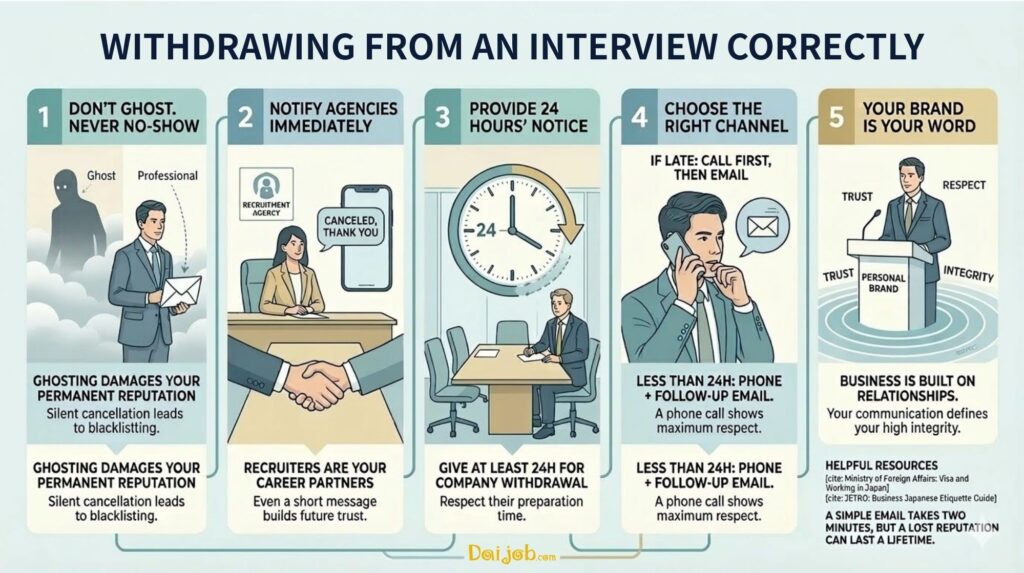
The recruitment world in Japan is very small. Hiring managers and recruiters often share networks. If you “ghost” a company, people will remember your name.
Ghosting or a “no-show” can:
・Damage your professional reputation permanently.
・Lead to being blacklisted by top recruitment agencies.
・Waste the valuable time of experts who prepared for you.
Point: Business is built on trust. A simple message shows you are a reliable professional.
Q: How should I handle a withdrawal with a recruitment agency?
Recruitment consultants are your career partners. They work hard to find roles that match your skills. Even if you decide not to pursue the roles they offer, failing to show up for a consultation is a breach of professional trust. If you decide to stop your search, notify them immediately. Even a short message is better than silence.
If you can no longer attend a meeting with a recruiter, follow these steps:
・Be honest: If you are no longer looking for a job, say so.
・Don’t wait: Even a short text or email is better than silence.
・Think of the future: Recruiters will keep you in mind for future roles if you are polite now.
Point: Recruiters talk to many companies. Keeping a good relationship with them opens doors later.
Q: What is the proper way of withdrawing from an Interview?
If you need to cancel an interview with a potential employer, timing is everything. You must respect their schedule.
・24-Hour Rule: Contact the company as soon as you decide. Give at least 24 hours of notice.
・Choose the right channel: Is the interview less than 24 hours away? Use a phone call first. Then, send an email. If the meeting is a few days away, a professional email is enough.
Q: What are some simple templates I can use to withdraw professionally?
Writing these messages can feel difficult. Use these simple templates to maintain professional etiquette.
Scenario A: Rescheduling due to an emergency (急な日程調整のご相談)
English
Subject: Rescheduling Request – [Position Name] – [Your Name]
Dear [Name], Please accept my apologies. I cannot attend our interview on [Date] due to an emergency. I am still very interested in this role. Can we reschedule for [Date] or [Date]? I am sorry for the inconvenience.
[Your Name]
Japanese
件名: 面接日程調整のお願い([職種名])- [氏名]
[採用担当者名、またはリクルーター名] 様
大変申し訳ございませんが、急な事情により、予定しておりました[日付/時間]の面接に伺うことが難しくなってしまいました。
貴社のお仕事には大変関心を持っております。もし可能であれば、以下の日程にて再度調整をいただくことは可能でしょうか。 [候補日 1] [候補日 2]
直前のご連絡となり、多大なるご迷惑をおかけしますことを深くお詫び申し上げます。
何卒よろしくお願い申し上げます。
[氏名]
Scenario B: Withdrawing after receiving another offer (選考辞退のご連絡)
English
Subject: Withdrawal of Application – [Your Name]
Dear [Name], Thank you for the opportunity to interview for [Position Name]. I am writing to withdraw my application as I have accepted another offer that matches my career goals. I appreciate your time and wish your company success.
[Your Name]
Japanese
件名: 選考辞退のご連絡 - [氏名]
[採用担当者名、またはリクルーター名] 様
この度は[職種名]の面接機会をいただき、誠にありがとうございました。
大変恐縮ながら、この度他社より内定をいただき、そちらへの入社を決意いたしました。つきましては、本選考を辞退させていただきたくご連絡申し上げます。
本来であれば直接お詫びすべきところ、メールでのご連絡となりますことご容赦ください。貴重なお時間を割いていただいたことに、心より感謝申し上げます。
貴社の益々のご発展をお祈り申し上げます。
敬具
[氏名]
Scenario C: Cancelling a meeting with an agency (面談キャンセルのご連絡)
English
Subject: Regarding our meeting on [Date] – [Your Name]
Dear [Recruiter Name], Thank you for your help with my job search. I have decided to put my job search on hold for now. Hence, I need to cancel our meeting on [Date].
I will contact you again when I am ready. Thank you for your understanding.
[Your Name]
Japanese
件名: [日付]の面談キャンセルと活動休止のご連絡 - [氏名]
[リクルーター名] 様
お世話になっております。キャリア相談のお時間をいただきありがとうございます。
現在の状況を鑑み、転職活動を一度休止することにいたしました。そのため、予定しておりました[日付]の面談を一度キャンセルさせていただきたく存じます。
また活動を再開する際には、改めてこちらからご連絡させていただきます。ご調整いただいたにもかかわらず、お手間を取らせてしまい申し訳ございません。
よろしくお願い申し上げます。
[氏名]
Q: Are there any final tips for sending these emails?
When you use these templates, remember these small but important details:
・Copy accurately: Make sure the company name and the person’s name are correct.
・Include the subject line: Japanese recruiters receive many emails. A clear subject line is vital for professional etiquette.
・Send as soon as possible: In Japan, “early notice” is more important than “perfect grammar.”
Take Away
Your professional reputation is your most valuable asset. Even if you don’t join a company today, you might meet those people again. You might even apply to that same company in three years. By being communicative, you show high integrity. A simple email takes two minutes to write. However, a lost reputation can last a lifetime.
Always choose professional communication over silence. It keeps your career path clear. Silence is a bridge-burner. A polite “No” in Japanese builds a future “Yes.”
Discover Your Next Role in Japan. Access more than 10,000 jobs for free!
- Jobs in Japan @ Daijob.com
- Expat Career Guide
- Tips & Advice
- Withdrawing from an Interview Correctly