
- Jobs in Japan @ Daijob.com
- Expat Career Guide
- Real Success Stories
- Career Change in Japan: How Mr. L Made it into a Global Firm
Expat Career Guide
Career Change in Japan: How Mr. L Made it into a Global Firm

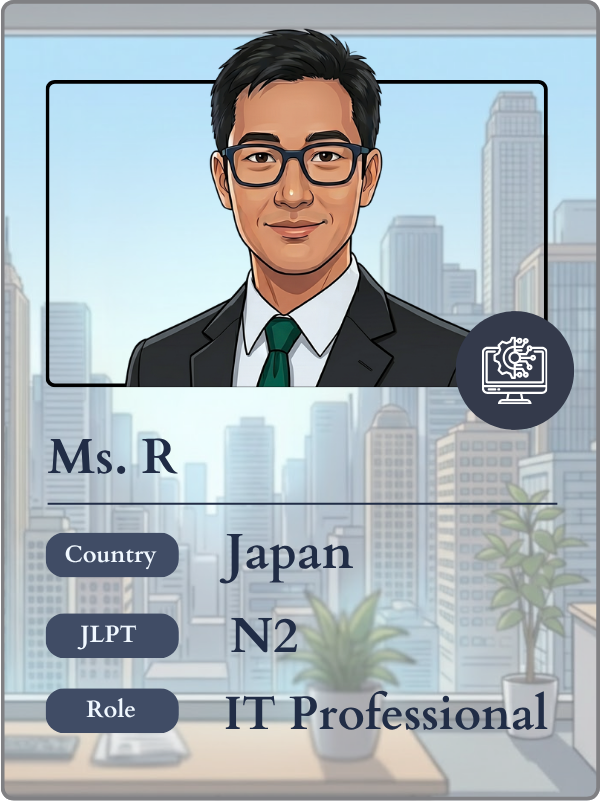
For many international professionals, the first few years of working in Tokyo or Nagoya can feel like a “test of fire.” You have the technical skills and the N2 certification, but you find yourself caught in a rigid hierarchy where even a simple Slack message feels like a high-stakes diplomatic mission. In 2026, the secret to a successful Career Change in Japan isn’t just about finding a new job—it’s about moving from being “just a worker” to becoming a “Strategic Bridge” in a global environment.
Today, we sit down with Mr. L, an IT professional from Myanmar living in Aichi. In just under three years, he transformed his “stagnant” situation at a traditional Japanese firm into a thriving role at a global automotive giant.
Part 1: The Turning Point: Why Mr. L Pursued a Career Change in Japan
Q: Mr. L, you originally moved to Japan for a “career up.” What was the reality of your first workplace that sparked the need for a change?
Mr. L: I started at a very traditional Japanese company. While the stability was good, the strict hierarchy was a major bottleneck for my professional growth. Even the smallest technical decisions required multiple layers of manager approval, which made simple tasks feel incredibly slow.
On top of that, every single document and chat was 100% in Japanese. As an N2 speaker, I could understand the content, but the nuance of business Japanese was a constant struggle. I felt like my skills were being wasted on paperwork rather than programming. I realized that if I wanted to reach my goal of becoming an Engineering Manager, I needed to execute a Career Change in Japan toward a more globalized environment.
Q: How did you manage to build your value while still stuck in that rigid environment?
Mr. L: I took a tactical approach. I started writing short Japanese messages first, then used translation tools to check the tone, keeping a personal log of common corrections. To prove I was ready for a Career Change in Japan, I looked for “gaps” in the team. I started writing small automation tools for the team outside of my regular tasks. This built a “portfolio” of extra work that proved I could provide value far beyond my job description.
Part 2: Overcoming Barriers during a Career Change in Japan
Q: What were the greatest difficulties you faced when you finally decided to pivot?
Mr. L: The hardest part was knowing how to find the right fit. When you are looking for career change opportunities in Japan, the sheer number of Japanese resumes (Rirekisho) and specific immigration rules can be overwhelming. I struggled with how to communicate my technical skills in a way that Japanese HR would appreciate, while also looking for a company that allowed “Secondary Jobs” (Fukugyo) and respected work-life balance.
Q: How did you use Daijob.com to simplify this process?
Mr. L: I needed a platform that understood the “Bilingual Struggle.” I used Daijob.com specifically because of the high number of global and foreign-affiliated (Gaishikei) opportunities. The “Scout Feature” and “AI Recommendations” were lifesavers. Instead of applying to 100 random jobs, I focused on 6 to 10 high-quality positions. The Automatic Resume Translation support also gave me the confidence that my Japanese documents were “Executive Level” before I even sent them.

Part 3: Strategizing Your Career Change in Japan with the Right Interview Prep
Q: You applied to several companies and landed 5 interviews. How did you prepare for the high-pressure questions?
Mr. L: I practiced structured answers and researched common behavioral questions. One difficult question was: “What would you do if your manager gave you an impossible deadline?” In my old job, the answer was just to work overtime. But for my Career Change in Japan, I wanted to show I belonged in a global culture. I explained how I would negotiate—picking the 3 “must-do” tasks and asking the manager which items could shift to the next day. This showed them I focus on efficiency, not just “staying late.”
Q: You received a very moving piece of feedback during this journey. Can you share it?
Mr. L: A Japanese mentor told me, “Your keigo is not perfect, but your honesty is clear.” That gave me the confidence that I didn’t need to be a “flawless” Japanese speaker to succeed. I just needed to be a trustworthy, skilled professional.
Part 4: Life After a Successful Career Change in Japan
Q: You are now working in the Automotive sector in Aichi. What is your satisfaction level?
Mr. L: It’s a 9 out of 10! My new company is a foreign-affiliated firm where my bilingual skills are treated as a strategic asset. My salary is stable, but my work-life balance has improved drastically. I no longer worry about “bottlenecks.”
Q: How do you plan to maintain that 9/10 satisfaction long-term?
Mr. L: My goal is to become an Engineering Manager. I’m concerned about technical communication during high-pressure server-down moments, but I’m using the same “log” method to improve. I manage my balance by picking 3 must-do tasks every day. If more work comes in, I communicate immediately rather than just doing everything late.
Part 5: Advice from a “Senpai”
Q: For those in Myanmar or elsewhere looking to change jobs in Japan, what is your #1 tip?
Mr. L: When you go through a Career Change in Japan, prepare your answer for “Why did you leave your last job?” very carefully. Don’t just say the hierarchy was bad. Explain that you wanted an environment where you could provide more value and take on more responsibility.
Q: Why was Daijob.com your choice for this journey?

Mr. L: Honestly, it was the Global Career Guide and the Automatic Resume Translation support. When you are stressed about your Japanese, having a platform that understands the “Bilingual Struggle” is a lifesaver.
I also highly recommend the Expat Career Guide on Daijob.com. It helped me understand the “hidden rules” of Japanese interviews. On a scale of 1 to 10, my satisfaction with the platform is a 10.
It’s the best hub for anyone serious about a professional pivot in 2026.
Take Away
Mr. L’s journey from Myanmar to a leading automotive firm in Aichi is a powerful roadmap for anyone currently navigating a Career Change in Japan. His story highlights a vital truth: you do not need “perfect” Japanese to escape a rigid hierarchy. What you need is a “Value-First” mindset and the courage to stop being a “bottleneck” and start being a solution.
If you are feeling “hierarchy fatigue” or find your technical growth stalled by slow approval chains, remember that the 2026 market is designed for specialists like you. A successful Career Change in Japan is about finding a culture that matches your speed. As Mr. L proved, when you combine your technical “extra work” with a platform that understands the bilingual struggle, a 10/10 job satisfaction rating isn’t just a dream—it’s your next reality.
Ready to start your own “Career Up”?
Mr. L’s story proves that you don’t need “flawless” Japanese to land a role in a top-tier global firm. You need a portfolio of extra effort and the right platform to showcase it.
Explore Global IT Roles on Daijob.com today.
Discover Your Next Role in Japan. Access more than 10,000 jobs for free!
- Jobs in Japan @ Daijob.com
- Expat Career Guide
- Real Success Stories
- Career Change in Japan: How Mr. L Made it into a Global Firm